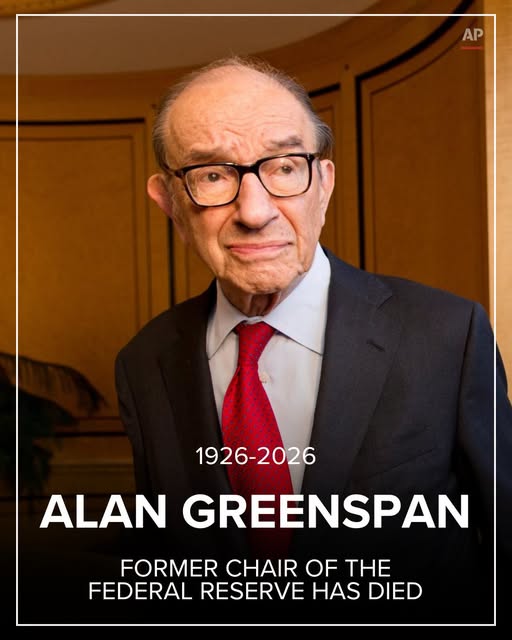
The global economic community is mourning the death of Alan Greenspan, the former Chair of the Federal Reserve, who has died at the age of 100. His passing was confirmed by his wife, NBC News correspondent Andrea Mitchell, in a statement shared on Monday.
Greenspan, one of the most influential economic figures of the modern era, passed away due to complications related to Parkinson’s disease. He died in Washington, where he spent much of his professional life shaping U.S. monetary policy.
Serving as Federal Reserve Chair from 1987 to 2006 under four U.S. presidents, Greenspan played a defining role in steering the American economy through multiple periods of growth and crisis. His tenure spanned major historical financial events, including the dot-com bubble and the early foundations of the subprime mortgage era.
Born in 1926 in New York City, Greenspan built a distinguished academic and professional career in economics before rising to national prominence. He earned degrees from New York University and Columbia University, later establishing himself as a respected economic consultant before entering public service.
His leadership at the Federal Reserve earned him global recognition, and for many years he was celebrated as a central figure in modern economic policy, often referred to as the “Maestro” for his influence on financial markets and monetary strategy.
However, his legacy also drew criticism following the global financial crisis that began after his tenure, with debates continuing over the long-term impact of his policies on financial regulation and housing markets. Greenspan himself later acknowledged that some assumptions about market self-regulation may have been misplaced.
Beyond his public career, Greenspan was known for his intellectual rigor and long-standing presence in economic policy discussions across several U.S. administrations. His death marks the end of a significant chapter in modern economic history.
He is remembered not only for his decades of public service but also for his influence on global financial systems and policy decisions that shaped generations.
 Greenspan, one of the most influential economic figures of the modern era, passed away due to complications related to Parkinson’s disease. He died in